


By Ian Varley, President, Cashway Funding
Over the years, I’ve spoken with hundreds of trucking business owners about their factoring arrangements. Carriers are hardworking people who need to get paid for the loads they’ve delivered quickly, keep their trucks moving, and grow their businesses.
And that’s exactly what freight factoring should help them do.
Unfortunately, not every factoring experience is a good one.
At Cashway Funding, we regularly speak with carriers who want to switch factoring companies because they’re unhappy with their current provider. Sometimes it’s poor service, unexpected charges, or simply feeling like they’re just another account number.
But occasionally, when we help a carrier move to Cashway, we encounter practices that leave us shaking our heads.
I call them the dirty tricks of factoring.
Not every factoring company operates this way. There are plenty of reputable providers doing a good job for their clients, but I’ve seen enough questionable practices to believe that every trucking business owner should take time to understand any hidden fees, contract terms, and potential penalties in their factoring agreement.
And perhaps most importantly, when they can leave and what it might cost them to get out.
1. Factoring Contract Hidden Fees: The Rate Is Only Part of the Story
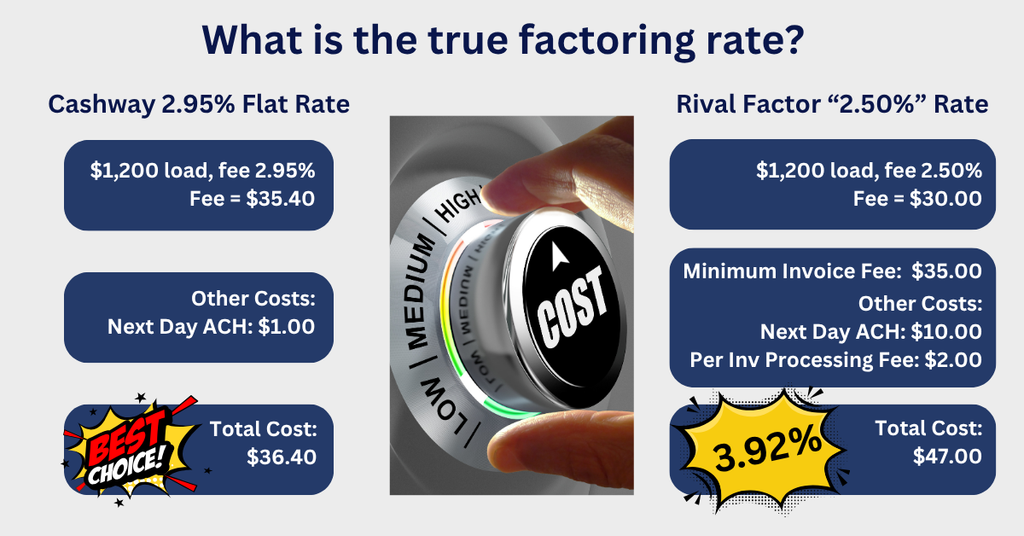
When comparing trucking factoring companies, it’s natural to focus on the factoring rate.
One company offers 2.5%, another offers 2.75%, and someone else promises an even lower rate.
The cheapest option seems like the obvious choice.
But that headline rate doesn’t always tell the whole story.
Depending on the factoring agreement, there may be additional charges for:
- ACH transfers and wire payments.
- Credit checks and account maintenance.
- Invoice processing and administrative services.
- Per invoice fee.
- Minimum monthly factoring fees.
- Minimum invoice fee.
- Other charges buried in the contract.
Some fees are perfectly reasonable. Factoring companies have operating costs, just like trucking businesses do.
The problem comes when those fees aren’t clearly explained upfront, or when a carrier discovers that the attractive headline rate they signed up for isn’t what they’re actually paying.
My advice? Ask for a complete breakdown of every factoring fee before signing.
Better still, ask the factoring company to show you what those charges would look like in a typical month based on your expected freight volume.
2. Factoring Contract Terms That Make It Difficult to Leave
This is one of the biggest surprises we encounter when helping trucking companies switch factoring providers.
A carrier decides it’s time for a change. Perhaps they’ve found better service, more competitive pricing, or a factoring company that better understands their business.
Simple enough, right?
Not always.
Some factoring contracts contain lengthy commitments, automatic renewals, strict cancellation notice requirements, and substantial termination penalties which can apply even when the required notice has been given within the specified time.
We’ve seen situations where a carrier believed their agreement was coming to an end, only to discover they’d missed the cancellation deadline and were automatically committed to another term.
Others have been presented with termination fees running into thousands of dollars even when that cancellation deadline was met.
Contract commitments and early termination fees aren’t necessarily unreasonable. After all, if a factoring company has offered a discounted rate in return for a longer commitment, it’s understandable that they’d want to earn a reasonable return on that arrangement.
But those terms should be clearly explained and understood before anyone signs.
Nobody should discover the true cost of switching factoring companies when they want to make the move.
3. Minimum Factoring Volume Requirements: Six Years Later, Here’s Your Bill!
One particular situation we’ve encountered deserves its own mention because, frankly, it was astonishing.
We were helping a carrier move away from their existing factoring company when the outgoing provider reviewed the carrier’s account history.
Not just the previous few months.
They went back more than six years.
The company examined the carrier’s factoring activity month by month, identified the odd periods when the carrier hadn’t met the minimum factoring volume requirements in their agreement, and calculated the charges it believed were owed.
Then, as the carrier was preparing to leave, those historical charges were presented for payment.
Think about that for a moment.
A trucking company could have been factoring with the same provider for years, receiving regular statements, paying fees, and continuing with business as usual.
Then, when it decides to move, it’s confronted with a bill for minimum volume shortfalls dating back years.
You might reasonably ask:
Why weren’t those charges raised in the months they occurred? Why wait until the relationship was ending? And what about the statute of limitations?
Those are fair questions.
Whether historical charges are legally recoverable depends on the factoring agreement, applicable state law, when the charges became due, and other circumstances. The age of a charge alone doesn’t determine whether it can still be collected.
But whatever the legal position, I believe there’s a fundamental difference between having a contractual right to charge a fee and treating a customer fairly.

If a minimum monthly factoring requirement applies, carriers should know about it, understand how it works, and be told promptly when they’re falling short.
Saving up years of alleged shortfalls and presenting them when someone wants to leave is hardly the kind of transparency that builds trust.
4. Switching Factoring Companies Shouldn’t Become a Nightmare
Another frustration we sometimes see involves the process of moving from one factoring company to another.
When a trucking company changes providers, its existing factor generally needs to confirm the outstanding balance, arrange for repayment, and release its security interest once the appropriate obligations have been satisfied.
There are legitimate steps involved, and they need to be handled carefully.
But we’ve also encountered situations where the process becomes unnecessarily difficult.
Unexpected charges appear. Payoff figures take longer than expected. Communication slows down. Or the carrier struggles to get a clear explanation of what’s needed to complete the move.
Meanwhile, that trucking business still has fuel to buy, drivers to pay, and loads to deliver.
That’s why we encourage carriers to understand their factoring contract’s cancellation requirements before starting the process.
A little preparation can help avoid expensive surprises and unnecessary interruptions to cash flow.
5. Five Questions Every Trucker Should Ask Before Signing a Factoring Contract
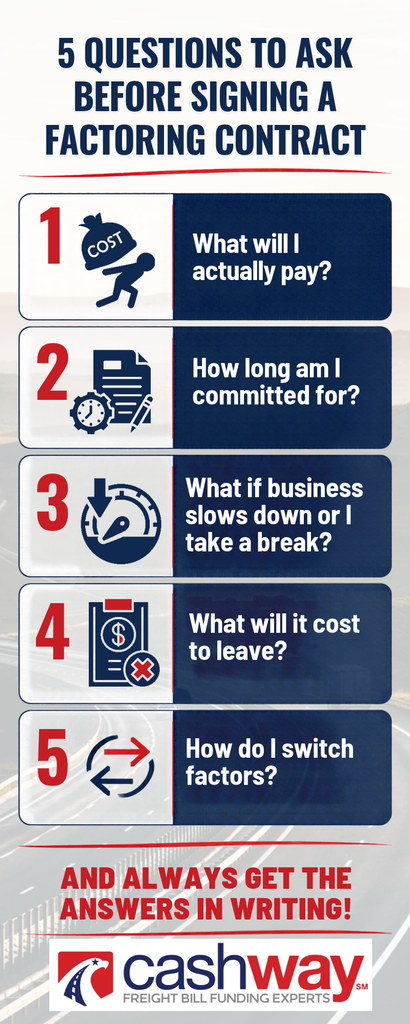
Whether you’re considering factoring for the first time or reviewing your current agreement, here are five questions I’d encourage you to ask.
1. What will I actually pay?
Look beyond the advertised factoring rate. Ask about transfer fees, monthly charges, minimum fees, and any other costs.
2. How long am I committed?
Understand the contract length, automatic renewal provisions, and how much notice you must give to cancel.
3. What happens if my trucking business slows down?
Find out whether minimum factoring volumes or monthly fees apply, even during quieter periods when you’re hauling fewer loads.
4. What will it cost me to leave?
Ask how early termination fees are calculated and whether other charges could become payable when you close your account.
5. How do I switch factoring companies?
Understand the payoff process, how outstanding invoices will be handled, and when the existing factor will release its security interest.
And one more thing:
Get the answers in writing.
A friendly conversation with a salesperson is great, but it’s the factoring agreement you sign that ultimately governs the relationship.
Freight Factoring Should Help Your Business, Not Hold It Back
I genuinely believe freight factoring is a fantastic tool for trucking companies. I wouldn’t have been in factoring for over 30 years if I didn’t.
Getting paid quickly, having someone help with invoicing and collections, and knowing you’ve got reliable cash flow can make a real difference to a growing trucking business.
But factoring should be a relationship built on trust, transparency, and good service.
At Cashway, we believe in being upfront about our pricing and contract terms, explaining what carriers can expect, and making sure they have real people they can talk to when they need help.
We’re not suggesting every carrier should switch factoring companies, or that every factoring contract with a commitment is a bad one.
What we’re saying is simple:
Know what you’re signing. Understand what you’re paying. And make sure you know what happens if you ever want to leave.
Because the last thing any trucking business needs is an unexpected bill from its factoring company when it’s simply trying to move forward.
Ian Varley
President, Cashway Funding
The Trinity + Cashway Advantage
For Trinity Logistics engaged carriers, there’s an added benefit to working with Cashway.
Trinity and Cashway are both part of the Burris Logistics family of companies, bringing together freight opportunities and financial support within the same broader organization.
It’s a simple idea: Trinity places the freight. Cashway helps get you paid.
When you haul eligible Trinity loads, Cashway handles the paperwork, invoicing and funding after delivery helping create a more seamless experience from finding the freight to receiving your money.
And because of the relationship between Cashway and Trinity, eligible Cashway clients can also benefit from reduced factoring rates on qualifying Trinity loads.
It’s another way to help carriers keep their trucks moving and their businesses growing.
Thinking About Switching Factoring Companies?
If you’re not completely happy with your current factoring arrangement, you don’t have to figure everything out on your own.
The Cashway team can help you understand the steps involved in changing providers, review the practical requirements of a transition, and explain how our factoring program works.
No pressure. Just real people, straightforward answers, and a team that cares about keeping your business moving.
Talk to Cashway About Making the Switch

Related Articles:
Why Reliable Factoring Matters More Than Ever for Trucking Companies in 2026